
Cherubim Are Not Chubby Babies with Wings
Proto-Tabernacle Series - Week 6

Every children’s Bible gets this wrong. Every Valentine card gets it wrong. Every nursery-wall sticker gets it wrong.
The cherubim stationed at the east of Eden in Genesis 3:24 are not cute little winged toddlers floating around with harps or arrows. They are not the pudgy infants we call “cherubs” in art galleries or greeting cards. Scripture never describes them that way…not once.
So what does the Bible actually say? Let’s slow down and read the text carefully, letting it speak for itself.
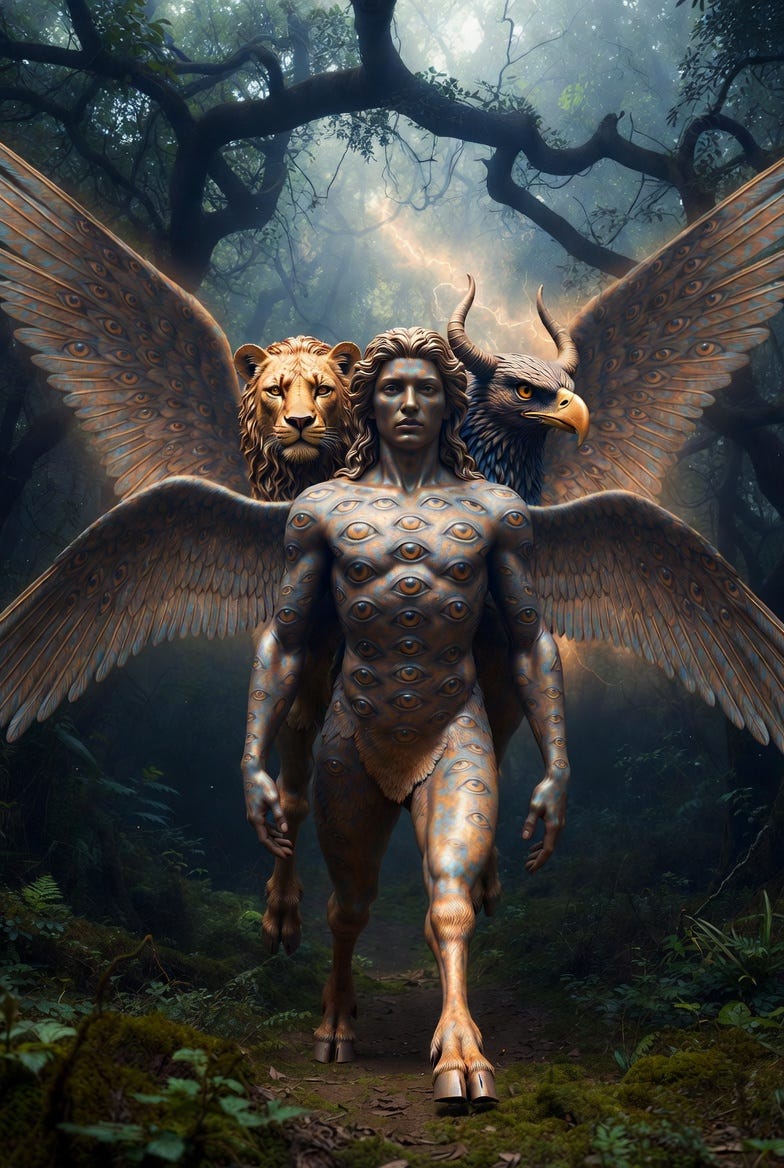
First Appearance: The Guardians of Life
Genesis 3:24 “So he drove out the man; and he placed at the east of the garden of Eden the cherubim and a flaming sword that turned every way to guard the way to the tree of life.”
After the Fall, God doesn’t just lock a door: He stations living, active guardians. Plural “cherubim.” A flaming sword that turns every direction. Their sole job: block any path back to the tree of life. This is the first and clearest picture of separation from God’s presence and eternal life. And these are not temporary sentries; they remain on duty from that moment forward.
The Full Description: Throne-Bearers Full of Eyes
The clearest portrait comes in Ezekiel’s visions. These are not different creatures; the text explicitly connects them.
Ezekiel 1:5–14 describes four living creatures:
Four faces each: the face of a man, a lion, an ox, and an eagle.
Four wings, with human hands under them.
Legs straight, feet like burnished bronze/calf’s hoof, sparkling.
Bodies and wings full of eyes all around and within.
They move in any direction without turning, like flashes of lightning.
Ezekiel 10:1–22 identifies them plainly: “These were the living creatures that I saw underneath the God of Israel by the Chebar canal; so I knew that they were cherubim” (v. 20). They carry God’s mobile throne-chariot. The wheels beside them are full of eyes. They go wherever the Spirit leads swift, unstoppable, terrifying in majesty.
These are not messengers running errands. They are the highest order of throne guardians, surrounding and bearing the very presence of God.
Woven and Carved Throughout the Sanctuary
From the very beginning of Israel’s tabernacle, cherubim appear everywhere God’s dwelling is represented:
Exodus 25:18–22: Two solid-gold cherubim on the mercy seat of the ark, wings spread upward, faces toward each other. God promises to speak from between them.
Exodus 26:1, 31: Cherubim embroidered on every curtain of the tabernacle and on the veil separating the Holy Place from the Most Holy.
1 Kings 6:23–29: In Solomon’s temple, two enormous olive-wood cherubim overlaid with gold: each 15 feet tall, wings spanning wall to wall and touching in the center. Cherubim carved on walls, doors, and panels throughout.
The pattern is unmistakable: wherever God’s holy presence dwells on earth, cherubim guard, surround, and adorn it. They remind everyone: this space is set apart. Access is restricted. Holiness is not approachable on our terms.
Revelation’s Throne Room Echo
Revelation 4:6–8 shows four living creatures around the throne, full of eyes in front and behind, six wings each, never ceasing to say, “Holy, holy, holy, is the Lord God Almighty.” Same four faces. Same ceaseless worship. These are cherubim, still guarding and proclaiming God’s glory in the final vision of Scripture.
Note: Temple liturgy experts - aka: the Rabbis - describe angelic praise as structured and rhythmic - e.g., Talmud Chullin 91b has ministering angels reciting the trisagion in phased groups daily, aligning with divine appointed patterns rather than chaotic endless repetition. The earthly sanctuary mirrored this heavenly order: perpetual in essence, yet majestic and timed.
Why the “Chubby Baby” Myth Took Over
Scripture never hints at cherubim as infants, winged or otherwise. That image comes from later art, not the text. During the Renaissance, artists revived classical Greco-Roman figures called putti small, plump, winged boys symbolizing love, innocence, or playfulness (think Cupid/Eros). Because they had wings, Christian painters repurposed them to represent “angelic” children or divine love in paintings of Mary, the Christ child, or heavenly scenes.
Over centuries, people started calling these cute putti “cherubs.” It was easier to paint approachable babies than multi-faced, eye-covered, lightning-fast beings that make humans tremble. The result? A complete reversal: what the Bible presents as terrifying throne guardians became sentimental nursery decor.
But sola scriptura demands that we return to the text. The cherubim blocking the way to the tree of life are the same majestic, fearsome creatures who carry God’s throne and fill the sanctuary curtains. They are not cuddly. They are holy. They remind us how far sin drove us from God’s presence and how impossible it is to return on our own.
Why This Matters Right Now
Right now, the only thing standing between humanity and the tree of life is a detachment of these very cherubim, still stationed since Genesis 3:24. The flaming sword still turns every way. Paradise remains guarded.
Yet Scripture doesn’t end in separation. The Proto-Tabernacle pattern we’ve been tracing points forward: from Eden’s east gate, through tabernacle veils, to the torn veil in the gospel, to the open access in Revelation 22 where the tree of life reappears no cherubim blocking the way, because the way has been opened by Another.
Next Saturday we finally examine the one piece of furniture Jesus said He was. The pattern explodes from there.
Blessings,
William
See you on the ancient paths.
© 2026 Galilee Publications. Just reading what’s written. Walk with us on the ancient paths.
Follow this Link for Weekly Note Bonus: Extra context & deeper dives: