
Forgotten Voices: Discovering the Minor Prophets Week 3
Habakkuk - Standing on the Watchtower

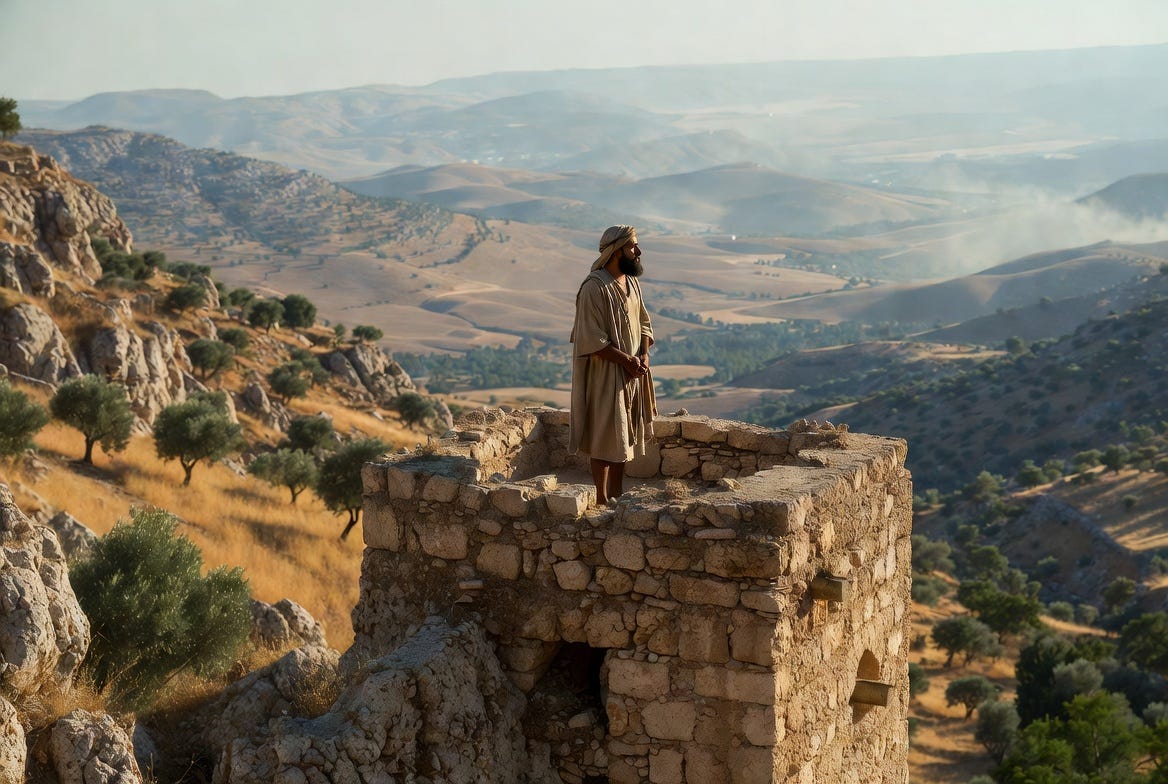
The Minor Prophets form one unified scroll. Their voices rise together against pride, injustice, and despair, always pointing toward the Day of the Lord. This week the focus narrows to one man who refuses to stay on the ground. Habakkuk climbs a watchtower and stations himself there until he receives an answer.
He is not only a prophet we study. He is a man living through real crisis, and the vantage point he takes is the same one you and I are still called to occupy.
The Climb
Habakkuk begins with honest complaint. Violence multiplies. Justice is twisted. The Biblical Law is set aside. He asks the questions that still live in every heart that longs for righteousness:
“How long, O Lord, shall I cry for help and You will not hear? Why do You make me see iniquity?”
God’s answer is more startling than the silence. “Look among the nations and see; wonder and be astounded. For I am doing a work in your days that you would not believe if told. For behold, I am raising up the Chaldeans…”
The instrument of judgment will be a nation more ruthless than the one being judged. The near horizon comes into clear view. Babylon is coming, and the first waves of that judgment would arrive within only a few years. The time is no longer distant.
Stationed on the Watchtower
Habakkuk does not turn away. He climbs higher.
“I will take my stand at my watchtower and station myself on the tower and look out to see what He will say to me.”
In the ancient world the tower was the place of far sight. From the ground you see only what is immediately in front of you. From the tower you can see the dust of approaching armies while there is still time to prepare. Habakkuk takes that higher vantage point. The watchtower is not a place of safety or distance. It is the place of clear seeing, the posture you must take when the near judgment is already moving and the final Day of the Lord still waits for its appointed time.
From that height both horizons become visible at once: the armies already on the march, and the glory that will one day fill the earth as the waters cover the sea.
The Word That Comes While Watching
While Habakkuk watches, the word arrives. The vision is made plain so that a runner may read it. It is for an appointed time. It will not delay. And in the middle of the five woes against the arrogant comes the sentence that becomes a hinge for the entire Book of the Twelve and for the New Testament itself:
“Behold, his soul is puffed up; it is not upright within him, but the righteous shall live by his faith.”
This is the only way to remain on the watchtower. The near judgment is certain. The far fulfillment is certain. The length of the wait is not given. Therefore the righteous live by faith, not by sight, not by full understanding, and not by favorable circumstances.
The Psalm from the Tower
Chapter 3 is not another oracle. It is a psalm.
It is introduced as “a prayer of Habakkuk the prophet, according to Shigionoth.” It carries the marks of temple worship: the word Selah and the final instruction, “To the choirmaster: with stringed instruments.” The language rises into classic theophanic poetry, the Divine Warrior advancing, mountains trembling, the sun and moon standing still. The man who climbed the watchtower in distress now leads the people of God in a song that can be taken up by the whole assembly.
Near the end of that psalm Habakkuk faces the full weight of barrenness:
“Though the fig tree should not blossom, nor fruit be on the vines, the produce of the olive fail and the fields yield no food, the flock be cut off from the fold and there be no herd in the stalls, yet I will rejoice in the Lord; I will take joy in the God of my salvation.”
The fig tree here is not a minor detail. In the language of the covenant, a barren fig tree is a sign of a people who have produced no fruit of righteousness. Habakkuk is looking at a Judah that has become barren, and he knows the near judgment is already on the way. Centuries later Jesus will stand before another fruitless fig tree on the road into Jerusalem and use it as a living sign that the time of judgment has drawn near. Both prophets confront the same people with the same urgent truth: the fruit is missing, and the time is near.
Habakkuk does not wait for the fig tree to blossom again before he rejoices. He accepts the barrenness, accepts the nearness of the judgment, and still chooses to root his joy in the God of his salvation. The Lord Himself is the true high tower of strength.
The Same Stage, the Same Call
The vision Habakkuk received still waits for its final appointed time. Jesus Christ is the Righteous One who lived by perfect faith. In Him the kingdom has broken in, yet the last Day of the Lord has not yet arrived. The glory that will fill the earth is still future. The armies of arrogance still move across the world.
If…IF…we are living in the last days, then you stand on the same watchtower Habakkuk occupied. The near rumbles of judgment and the far certainty of God’s triumph are both in view. The word spoken to the man on the tower is spoken directly to you:
The righteous shall live by his faith.
Living on the Watchtower
The call is not to come down. The call is to take the posture of far sight. Keep your eyes open. Keep your heart steady. Refuse both despair and false security. Watch. Wait. Live by faith in the God who has already declared the end from the beginning, even when the fig tree does not blossom. He Himself is your strong tower.
This Week’s Challenge Read the entire book of Habakkuk aloud in one sitting. (Or go to BibleHub.com and use their audio feature and listen to it in the car on the way to work.) It takes only a few minutes. Pay close attention to the moment the prophet stations himself on the watchtower and to the psalm that rises from that place. Then ask the Lord where He is inviting you to take the same stand of far-sighted faith.
The ancient paths still call.
The watchtower still stands.
The same word still holds.
William