
He Walked on the Sea
Christ’s Power Over Leviathan and the Promise of No More Chaos

Imagine the dead of night on the Sea of Galilee. Waves crashing, wind howling, the boat taking on water. The disciples experienced fishermen are terrified.
Then, through the storm, a figure appears… walking on the water.
Jesus speaks:
“Take heart; it is I. Do not be afraid.” (Matthew 14:27)
He steps into the boat and says to the raging sea:
“Peace! Be still!” (Mark 4:39)
Instant calm. The disciples are left whispering:
“Who then is this, that even the wind and the sea obey him?”
We often read this as a beautiful miracle proving Jesus’ divinity or teaching us about faith in storms. But there’s a deeper biblical pattern here one that connects directly to ancient chaos, a monstrous serpent, and the ultimate hope of a world without turmoil.
The sea in Scripture isn’t just a body of water. It’s the symbol of primordial chaos, rebellion, and the dwelling place of evil.
The Sea: Realm of Chaos and Untamed Rebellion
From the very beginning, the Bible portrays the sea as restless and threatening. The Spirit hovers over “the deep” in Genesis 1:2 a formless, chaotic abyss. God gathers the waters and sets boundaries (Genesis 1:9–10; Job 38:8–11), but they remain volatile, always pushing against the limits He decreed.
Look at Jeremiah 5:22:
“Do you not fear me? declares the LORD... I placed the sand as the boundary for the sea, a perpetual barrier that it cannot pass; though the waves toss, they cannot prevail; though they roar, they cannot pass over it.”
Yet the waves roar like invading armies (Isaiah 17:12; Jeremiah 6:23). Nations surge like restless waters (Psalm 65:7). The wicked are compared to the troubled sea, casting up mire and dirt (Isaiah 57:20).
Why this obsession with the sea’s restlessness? Because it represents forces that oppose God’s order untamable by human power, alien and fearsome to land-dwelling Israel.
The Monster in the Deep: Leviathan, the Twisting Serpent
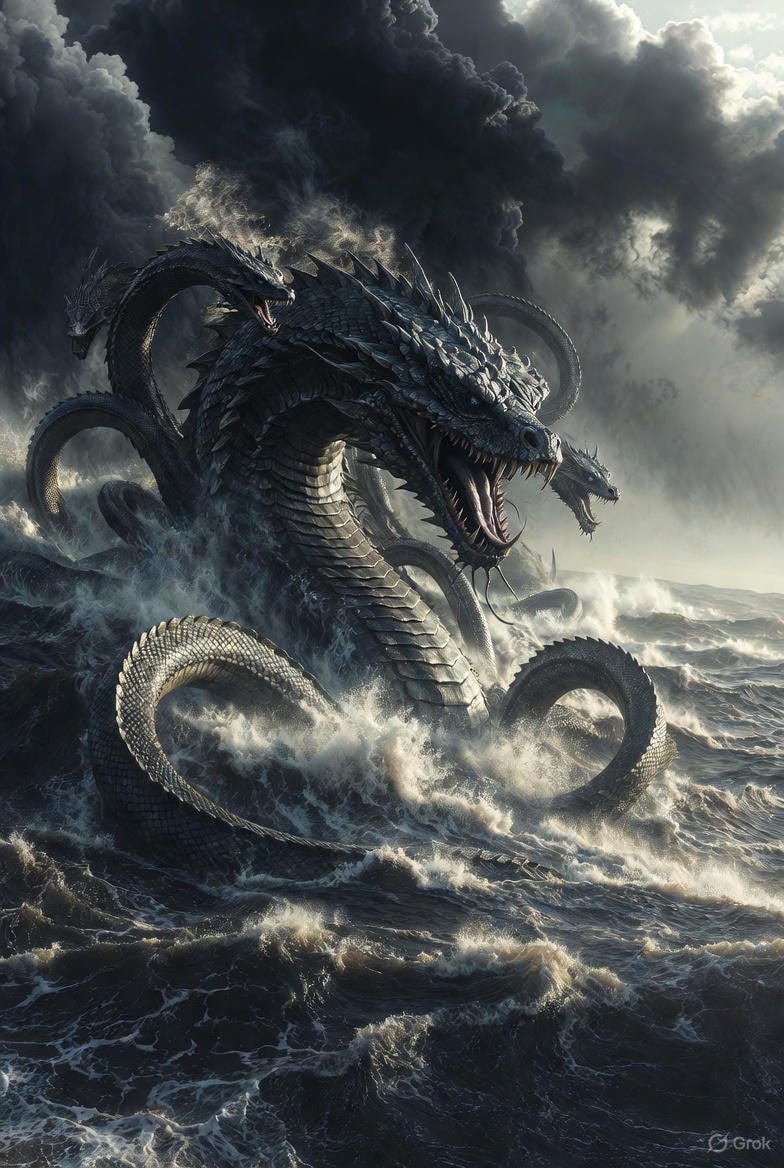
And lurking in that chaotic sea is the great monster.
Scripture calls it Leviathan the fleeing, twisting serpent (Isaiah 27:1), also Rahab or the dragon (Job 26:12–13; Psalm 89:9–10; Psalm 74:13–14).
This isn’t a literal crocodile or passing whale. It’s the embodiment of cosmic rebellion often multi-headed in ancient imagery, breathing fire and terror (Job 41).
No human can subdue it:
“Can you draw out Leviathan with a fishhook or press down his tongue with a cord?” (Job 41:1)
Men harpooned great sea creatures (what whalers called “leviathans”), but the true Leviathan laughs at spears (Job 41:29). Only God can put a hook in its nose or slay it with a sword.
Now connect to Revelation: A beast rises from the sea with seven heads, ten horns, and blasphemous names (Revelation 13:1). It’s empowered by the great red dragon, explicitly “that ancient serpent, who is the devil and Satan” (Revelation 12:9; 20:2).
The pattern is clear: The sea is the domain from which evil powers emerge. Leviathan symbolizes the ultimate chaotic rebel Satan himself.
A Pattern in Israel’s Story: Land vs. Sea
This sea/chaos theme shapes Israel’s identity. God’s promise to Abraham centers on the land (Genesis 17:8) bounded, fruitful inheritance. Israel never becomes a major seafaring nation despite coastal access.
They rely on foreign experts: Solomon’s grand fleets are joint with Hiram of Tyre (1 Kings 9–10), bringing wealth but also risks Egyptian horses, foreign wives, multiplied gold violating Deuteronomy 17:16–17.
Jehoshaphat’s independent ships wreck under judgment (2 Chronicles 20:35–37). End-time prophecies picture Gentile “ships of Tarshish” serving Israel’s restoration (Isaiah 60:9).
While not explicitly forbidden, the pattern suggests caution: Sea-entanglements (trade alliances, global wealth) can pull toward compromise, mirroring how chaos surges against boundaries.
Solomon’s glory built partly on sea-trade prosperity was executed through heavy forced labor on Israelites (1 Kings 5:13–18), sowing burdens that erupted after his death (1 Kings 12:4).
Prosperity from the “sea” can subtly erode Israel’s land-centered faithfulness.
Christ’s First Coming: Striding Over the Dragon’s Domain
When Jesus walked on water, He echoed what only God does:
Trampling the waves (Job 9:8)
Crushing dragons in the waters (Psalm 74:13)
He reenacted the Red Sea parting drowning Pharaoh, another “dragon” (Ezekiel 29:3).
It was grace amid the storm: coming to fearful disciples, calming to reveal, “I am” Yahweh’s name.
A foretaste of full authority.
The Second Coming: Hook, Sword, and Eternal Calm
Next time, no gentle preview.
“In that day the LORD... will punish Leviathan the fleeing serpent... and slay the dragon in the sea.” (Isaiah 27:1)
The hook set. Serpent bound (Revelation 20:2). Beast defeated. Dragon cast into fire.
Final vision:
“A new heaven and new earth... and the sea was no more.” (Revelation 21:1)
No sea no domain for chaos, no residence for the ancient serpent. Peace reigns forever by Messiah’s power.
Back to That Boat: Hope in Today’s Storms
The disciples thought they’d drown. Their terror became Jesus’ pathway.
Today, seas rage personal trials, global turmoil, deception surging.
But the voice that said “Peace, be still” speaks still: “Take heart; it is I.”
He’s coming again to silence the deep forever.
What does this change for you seeing the storm miracle as preview of Leviathan’s defeat? How does “no more sea” fuel your hope?
Share below I’d love your thoughts. (And if you want more on land/sea patterns or Solomon’s cautionary tale, just say.)