
Meditating on the Robe in Scarlet and Purple: A Passover Reflection on a Small but Striking Detail

Welcome to this special edition from the shores.
As the season of Passover approaches, the time when the lamb was slain and its blood marked the doorposts for deliverance (Exodus 12:7, 13), we remember the crucifixion of our Lord Jesus, “our Passover” sacrificed for us (1 Corinthians 5:7).
In the accounts of His mocking before death, the soldiers placed a robe on Him after scourging: scarlet according to Matthew (27:28), purple according to Mark (15:17) and John (19:2).
This small variation stands out. Eyewitnesses to such intense suffering would not overlook the garment draped over His wounded body. Yet the descriptions differ slightly. Why? Not a contradiction, but an invitation to look closer at what was seen, how it was perceived, and what it points to in Scripture.
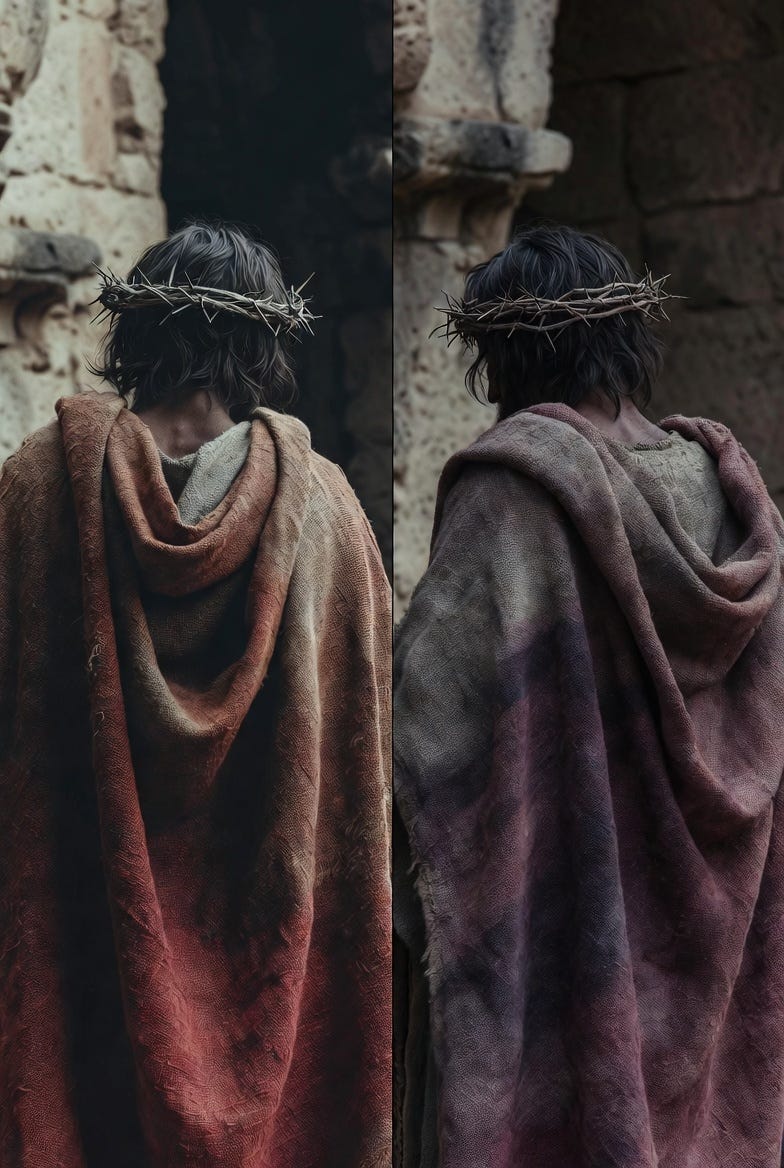
Ancient Dyed Fabrics Were Varied in Color
The Practical Realities – Why the Color Might Appear Different
Ancient dyes were not uniform like today’s colors. Purple (from sea snails, often called Tyrian purple) produced reddish-purple shades that varied with batch, fading, and treatment. Scarlet came from insects or plants, overlapping in the red-purple range. A cheap soldier’s cloak, likely faded and military-issue, would not hold a perfect hue.
Light, angle, and saturation played big roles. In the dim Praetorium (judgment hall with flickering lamps and limited windows), the robe could shift appearance. Viewing from one direction (say, facing east toward Christ, with cooler shadows) might emphasize deeper purple tones. From the opposite (facing west, with warmer afternoon light hitting the fabric), red highlights could stand out more. Saturation changed too: as blood from scourging and thorns soaked in over minutes, the garment absorbed stains, making it appear more crimson/scarlet. These factors explain surface differences without denying the same robe was used.
Eyewitness Authenticity – Proof These Are Real Witness Accounts
The apostles (and their sources) wrote from what they saw, not a scripted story. Real eyewitness reports include minor perceptual variations: timing of arrival, viewing angle/direction, light effects, blood progression all while agreeing on the core facts - soldiers mocked Jesus as King with a robe, crown of thorns, and reed.
Matthew (or his perspective) may have arrived/viewed later, seeing a blood-soaked, shifted scarlet. Mark and John captured the initial purplish appearance for royal mockery. If all accounts matched word-for-word, it would suggest copying or invention. Instead, these subtle differences prove independent, honest testimonies from men who were there. The variation itself testifies to the reality of the events during that Passover week.
Deeper Layers – Reflection and Prophetic Hints
After the resurrection, the apostles reflected together, guided by the Spirit (John 14:26). Their word choices highlight facets: purple underscores the irony of the true King scorned (royal color in Daniel 5:29; Esther 8:15). Scarlet points to sin’s deep stain and redemption (“though your sins be as scarlet, they shall be white as snow,” Isaiah 1:18).
Matthew’s scarlet view may also carry a forward prophetic glance. God taking opportunity to tell Matthew about a future event. In Revelation 19:13 (John’s vision), the returning Christ also wears a robe “dipped in blood,” a vivid, blood-red image of judgment and triumph (echoing Isaiah 63:1-6). The mocking robe, bloodied from suffering, unwittingly foreshadows that victorious return. Two apostles talk about a scarlet robe in scripture and the nuances are striking. Estimating the exact “why” is difficult, perception, symbolism, or Spirit-led emphasis, but all layers point to the same truth.
While these layers point forward to future fulfillment, Scripture also uses the same colors in a sobering contrast…
A Striking Contrast – The Woman in Revelation 17
Revelation uses purple and scarlet again, but in inversion. The woman (Babylon the Great) is “arrayed in purple and scarlet” (17:4), adorned with gold and jewels, holding a cup of abominations. The woman appears to be a mimic as deception. She is clothed in the guise of Christ but is not of the body.
This contrasts sharply with Christ: the robe on His flesh during mockery echoes holy colors but leads to true redemption. The woman’s attire parodies that, false authority and corruption imitating the real King and Lamb. The colors remind us to discern: the true sacrifice (His blood for deliverance) from deceptive images.
Conclusion: The Strongest Connection – The Veil of His Flesh
The most compelling tie is the tabernacle veil woven with blue, purple, and scarlet threads (Exodus 26:31; 36:35), separating holy God from sinful man. Scripture declares Jesus fulfills this: we enter God’s presence “by a new and living way… through the veil, that is, his flesh” (Hebrews 10:19-20).
The robe, scarlet and purple, was placed on that very flesh, echoing the veil’s colors amid real suffering. His stripes from scourging (Isaiah 53:5: “with his stripes we are healed”) caused the bleeding; the robe added unwitting symbolism. At death, the temple veil tore top to bottom (Matthew 27:51; Mark 15:38), with earthquake and darkness, God’s signs removing the barrier. During Passover, the Lamb’s blood delivers (Exodus 12:13 fulfilled in Him).
Mockery became prophecy. The torn veil means access through His broken body. As we remember His death till He comes (1 Corinthians 11:26), this detail draws us nearer to the Lamb who takes away the sin of the world (John 1:29).
What small detail from the Passover events has caused you to pause and meditate lately? Pull up a chair and we will partake in His offering together with thanksgiving and praise.
Blessings,
William
See you on the ancient paths.
© 2026 Galilee Publications. Just reading what’s written. Walk with us on the ancient paths.
Follow this Link for Weekly Note Bonus: Extra context & deeper dives: