

A question lingers across the church: “Where are the miracles and healings we read about in Acts?”
The common reply comes quickly: the early church was more faithful, more righteous, more spiritually mature. They paid a price later generations have refused.
This answer comforts. It is also demonstrably false.
Open the New Testament and examine the people through whom God moved in power. James and John sought the two highest seats in the kingdom while the cross remained ahead of them (Mark 10:35–41). Peter, the rock, fell into ethnic hypocrisy in Antioch and drew Barnabas with him (Galatians 2:11–14). The Jerusalem church allowed Greek-speaking widows to be overlooked while Hebrew widows were cared for (Acts 6:1). Pride, cowardice, tribalism, and favoritism appear openly.
Yet through these same flawed vessels the dead were raised, the lame walked, and entire cities turned to the Lord.
Moral superiority, then, is not the variable that releases kingdom power.
The Controlling Pattern: Numbers 19
Scripture provides one clear picture of how such power operates. Numbers 19 describes the unique ritual for removing corpse-defilement (טֻמְאַת מֵת) from the covenant people.
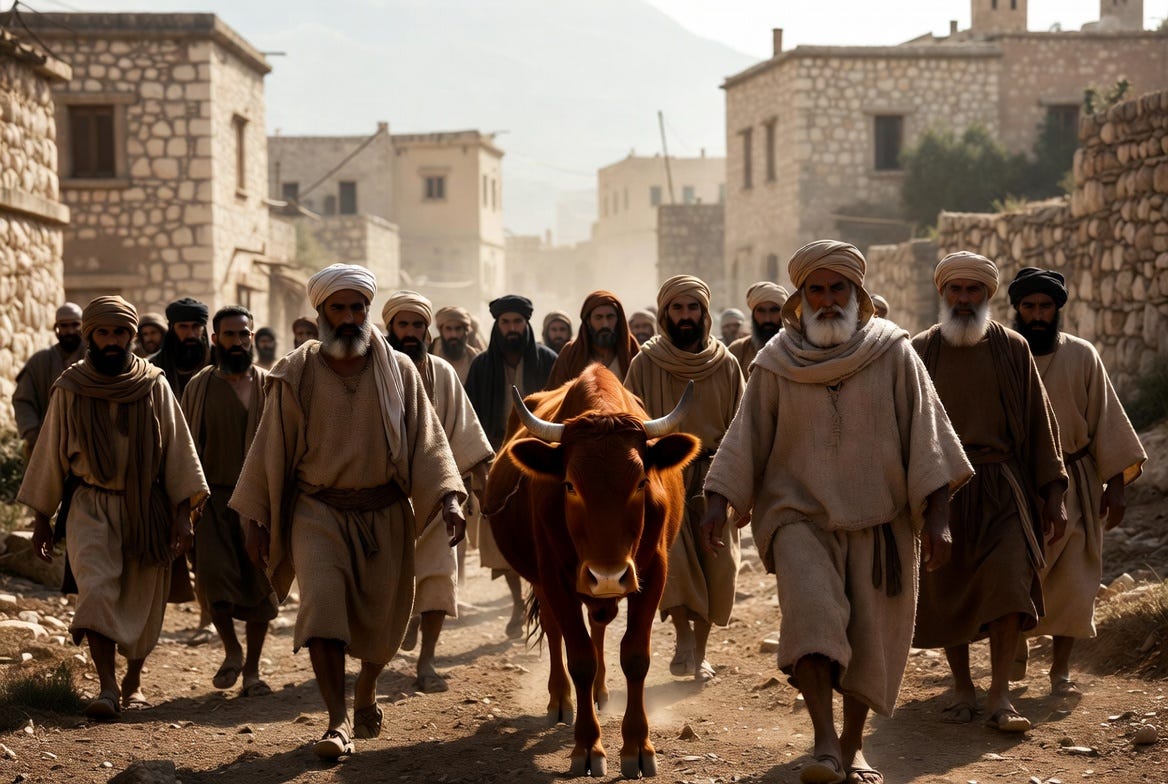
A red heifer, perfect, never yoked (תָּמִ֨ים… לֹא־עָלָ֥ה עָלֶ֛יהָ עֹ֖ל, Numbers 19:2), is led outside the camp (מִח֖וּץ לַֽמַּחֲנֶ֑ה). It is slaughtered. Its blood is sprinkled seven times toward the tabernacle. The entire carcass, hide, flesh, blood, and dung, is burned to ashes. Everyone involved in the process becomes ceremonially unclean until evening.
The ashes are then gathered and mixed with running water to create the water of purification. The only provision that cleanses the nation from death’s pollution requires those who produce it to become defiled and exiled from the camp in the very act.
This is the unchanging logic of the kingdom: holiness enters a contaminated world through willing bearers who step outside.
Fulfilled in the Messiah
The writer of Hebrews makes the connection plain: “For the bodies of those animals… are burned outside the camp. Therefore Jesus also, that he might sanctify the people through his own blood, suffered outside the gate. Therefore let us go to him outside the camp and bear the reproach he endured” (Hebrews 13:11–13).
The red heifer finds its perfect fulfillment in Jesus the Messiah. The “ashes” were gathered once for all on Golgotha. Mixed with the living water that flowed from his pierced side, the water of purification now flows freely.
All that remains is for willing hands to carry those ashes back into a world still stained by death.
The Historical Pattern
Every sustained carrier of kingdom power in Scripture ends up outside the camp:
Moses, rejected by his own and buried in obscurity.
Elijah, hunted and sustained in isolation.
Jeremiah, cast into a cistern and imprisoned.
Jesus, crucified outside Jerusalem’s gate.
Paul, beaten, stoned, shipwrecked, and finally executed.
The early church, scattered by persecution the moment the Spirit fell (Acts 8:1).
None chose exile for its own sake. They simply obeyed until the gate closed behind them.
The Modern Reversal
For centuries, the visible church has labored to widen the camp, secure respectability, and build institutions that keep everyone safely inside. The desire remains: the water of purification without anyone standing in the smoke, resurrection power without anyone becoming unclean for the sake of the dying.
This refusal to pay the red-heifer price, not lack of fasting, correct doctrine, or abstract faith, is the primary reason sustained, public miracles remain scarce.
The Cost Named by the Lord
Jesus stated the terms plainly: “If anyone comes to me and does not hate by comparison his father and mother, wife and children, brothers, and sisters, yes, even his own life, he cannot be my disciple. Whoever does not forsake all that he has cannot be my disciple” (Luke 14:26–33).
First-century ears heard these words without softening: following the Messiah far enough would cost family, synagogue, reputation, livelihood, and sometimes life itself. Every generation that witnessed the Acts-level outpouring answered with willingness. The question for this generation is whether the same willingness will be offered again.
The Ashes Remain
The fire has already burned. The blood has been sprinkled seven times toward the sanctuary. The provision for a corpse-contaminated world stands ready.
Nothing prevents the flow of power except the hesitation to become unclean for the sake of the lost.
The early church was not more righteous. They were simply more willing.
That willingness remains available. The Spirit has not been withdrawn. The promise has not expired.
What is required is a company of disciples who will stop flinching, pick up the ashes, and walk toward the corpses.
When that company forms, the camp will discover what it has always secretly needed: the power was never locked in the past. It was only waiting for carriers.
The question is no longer “Where are the miracles?” The question is “Who will carry the ashes?”
Follow this link for the expanding note and deeper context: