

Galilee Gazette - Issue #33
By your humble correspondent in Jerusalem, the 12th day of the month of Tammuz, in the 17th year of Tiberius Caesar.
JERUSALEM - Yesterday at the Temple, two very different men went up to pray. One was a first-rate, card-carrying Pharisee: star of the purity league, fasting twice weekly while the rest of us managed once a year on Yom Kippur. The other? A tax collector. Yes, that kind: the fellow who’d cheerfully auction off his grandmother’s goat to meet Rome’s quota and still pocket enough for a new villa.
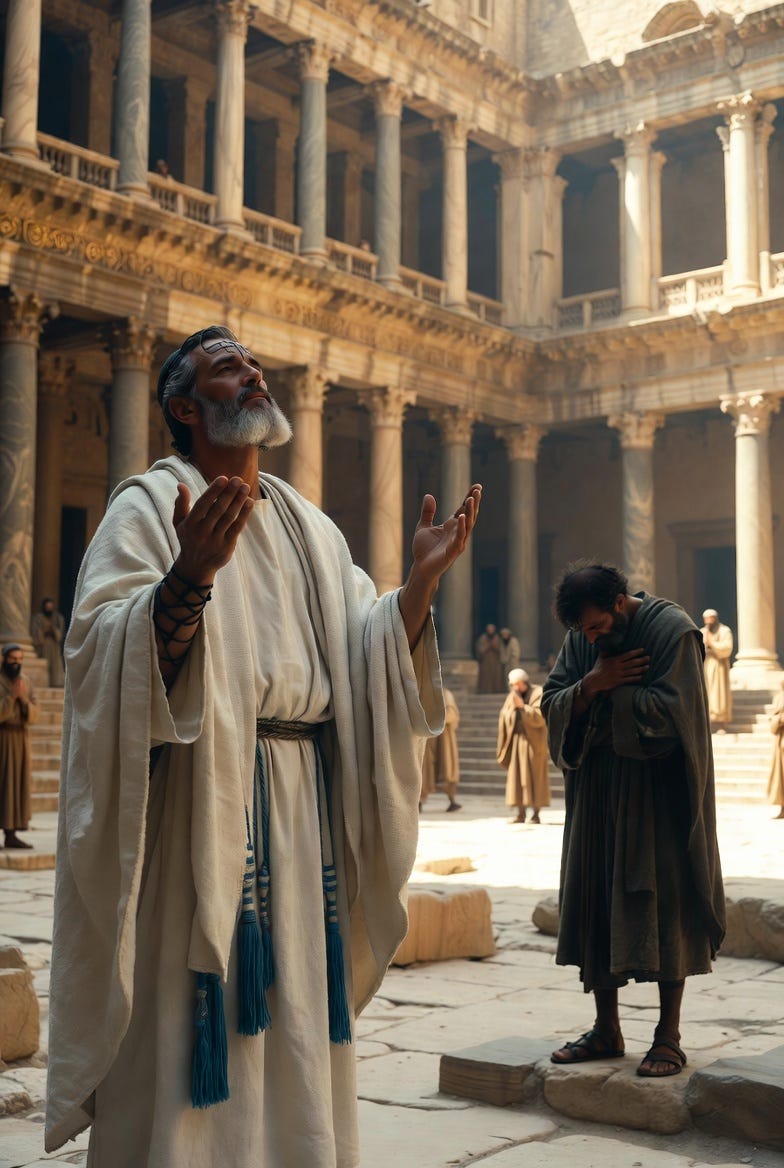
The Pharisee planted himself front and center like a victorious general and launched into his prayer with all the flair of a Greek orator on opening night: “God, I thank You that I am not like other men, robbers, evildoers, adulterers, or even like this tax collector over here. I fast twice a week. I tithe everything, right down to the spices in my cupboard.” One could almost hear the heavenly choir warming up for his victory lap.
A short distance away, the tax collector couldn’t even lift his eyes to heaven. He stood there beating his chest like a man who’d just realized his entire ledger was written in disappearing ink and muttered, “God, have mercy on me, a sinner.”
According to the Galilean teacher who witnessed the whole affair, the tax collector, not the spiritual all-star, went home justified. The proud man’s prayer apparently bounced off the Temple ceiling, while the humble one slipped straight through to the Throne. In a city full of honor-shame scorekeeping, this was the equivalent of the underdog beating the champion with a single quiet sentence.
The reversal has everyone buzzing. Pharisees are the respected Torah commandos of Judea, heroes who kept the faith alive under Roman boots (Josephus himself notes their sway with the common people). Tax collectors? Professional collaborators who bid for the right to wring coins from their neighbors for Caesar’s coffers. They make Roman toll booths look like charity drives.
Even the Stoics might raise an eyebrow. Epictetus spent his days drilling students on mastering inner judgment over external show, while here a man who mastered nothing but regret found favor. The Pharisee offered God a résumé. The tax collector offered a broken heart.
Guess which one the Almighty preferred?
Cultural Shocks Most Modern Readers Miss
The “good guy” was the villain of the story. Pharisees were the devout overachievers everyone admired, not lazy hypocrites. Jesus flipped the script on the most respected religious professionals of the day.
Tax collectors were basically ancient IRS agents with swords. They bought the right to overcharge their own people for Roman taxes. Showing up at the Temple was like a loan shark attending a holiness convention.
Prayer wasn’t private therapy. It was public performance art. Standing tall with hands raised signaled “I’ve got this, God.” The tax collector’s distant, chest-beating posture screamed public shame, exactly the opposite of what respectable worship looked like.
God doesn’t grade on spiritual effort points. In a world of patronage, public piety, and visible status, Jesus said the quiet, desperate plea from the back row carried more weight than the polished speech from center stage.
Biblical Shocking Takeaway
God justifies the honest failure who begs for mercy and not the impressive success who lectures Heaven on his achievements.
Which of these two men do you secretly identify with more when you approach God in prayer-the disciplined achiever listing accomplishments, or the outsider who can only plead for mercy? Why? Share your thoughts below.
© 2026 Galilee Publications
Rush the shores where real repentance is passionate and the sinner is justified through it.