

CORINTH COURIER Galilee Publications - Issue #35
By your humble correspondent in Corinth, the fifth day before the Ides of the month of harvest, in the year of the emperor’s fifteenth tribunician power
News has reached the docks of Corinth that a certain Galilean teacher stood in the temple courts of Jerusalem and told a story so pointed the chief priests and Pharisees tried to arrest him on the spot.
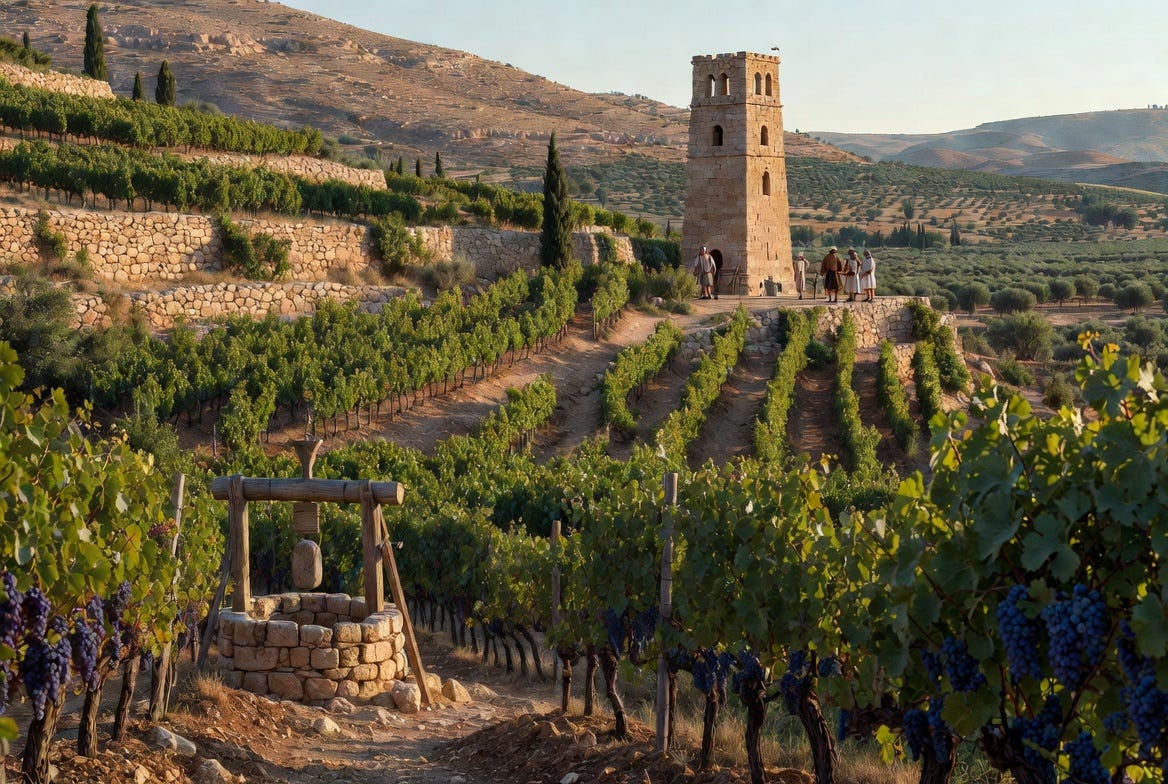
A landowner, the teacher said, planted a vineyard, put a wall around it, dug a winepress, and built a watchtower. Then he leased it to tenants and went abroad. At harvest he sent a servant to collect his share of the fruit. The tenants beat him and sent him away empty-handed. He sent another. They struck that one on the head. He sent still more. Some they beat, some they killed. Finally the owner said, “I will send my beloved son. They will respect him.”
The tenants saw the heir coming and said to one another, “This is the heir. Come, let us kill him and the inheritance will be ours.” So they seized him, threw him out of the vineyard, and killed him.
What, the teacher asked the crowd, will the owner of the vineyard do? He will come and destroy those tenants and give the vineyard to others.
The temple leadership knew at once the story was aimed at them. In Corinth we understand land, tenants, and inheritance law rather well. A patron who keeps sending agents after the first three have been assaulted is either a fool or a man of terrifying patience. The tenants’ logic is the kind of short-term cleverness that ends with crucifixion or the arena. Yet the Galilean told it in the very courts the tenants currently controlled.
Echoes Across the Ages
This is not a new story. It is the old story wearing new clothes.
Centuries earlier the prophet Isaiah sang of a vineyard that belonged to the Lord of hosts. He cleared it, planted it with choice vines, built a watchtower, and hewed out a wine vat. He looked for justice and found bloodshed; for righteousness and heard a cry. The vineyard of the Lord of hosts is the house of Israel, and the men of Judah His pleasant planting. Judgment was already spoken over that vineyard long before any Galilean teacher stood in the temple.
The servants sent to collect the fruit are the long line of prophets. Generation after generation they arrived with the same message. Generation after generation they were beaten, mocked, or killed. The pattern is so consistent that later writers could speak of “the blood of the prophets from Abel to Zechariah” as a single continuous debt.
Then comes the final, almost reckless act: the owner sends the son. Not another servant. The heir. The one whose very presence announces that the time of patience is ending. The tenants’ response is the logical climax of the entire pattern, if you have already killed the messengers, the only way to keep the vineyard is to eliminate the heir.
And the stone the builders rejected has become the cornerstone. The teacher closed the parable with the ancient psalm that every pilgrim knew. The rejected one becomes the foundation. The vineyard is taken away and given to others.
Modern Blind Spot
Most modern readers hear a gentle lesson about stewardship or “giving God His due.” First-century ears heard a public death sentence pronounced on the current management of the vineyard, delivered to their faces in their own courts. The humor, if one can call it that, is the tenants’ absolute confidence that murdering the heir will finally secure what the owner has never surrendered.
Biblical Shocking Takeaway The vineyard was never theirs to keep. The only question left is whether the new tenants will produce the fruit the owner has always required.
Reader Discussion Prompt If the tenants’ logic (“Kill the heir and the inheritance is ours”) still sounds reasonable to any part of us, what does that reveal about the stories we tell ourselves when we want to keep control?
© 2025–2026 Galilee Publications
Rush the shores, where the tenants’ logic has been weighed and found crazy.