
The Angels at Eden Didn’t Just Stand There, They Tabernacled
Proto-Tabernacle Series – Week 9

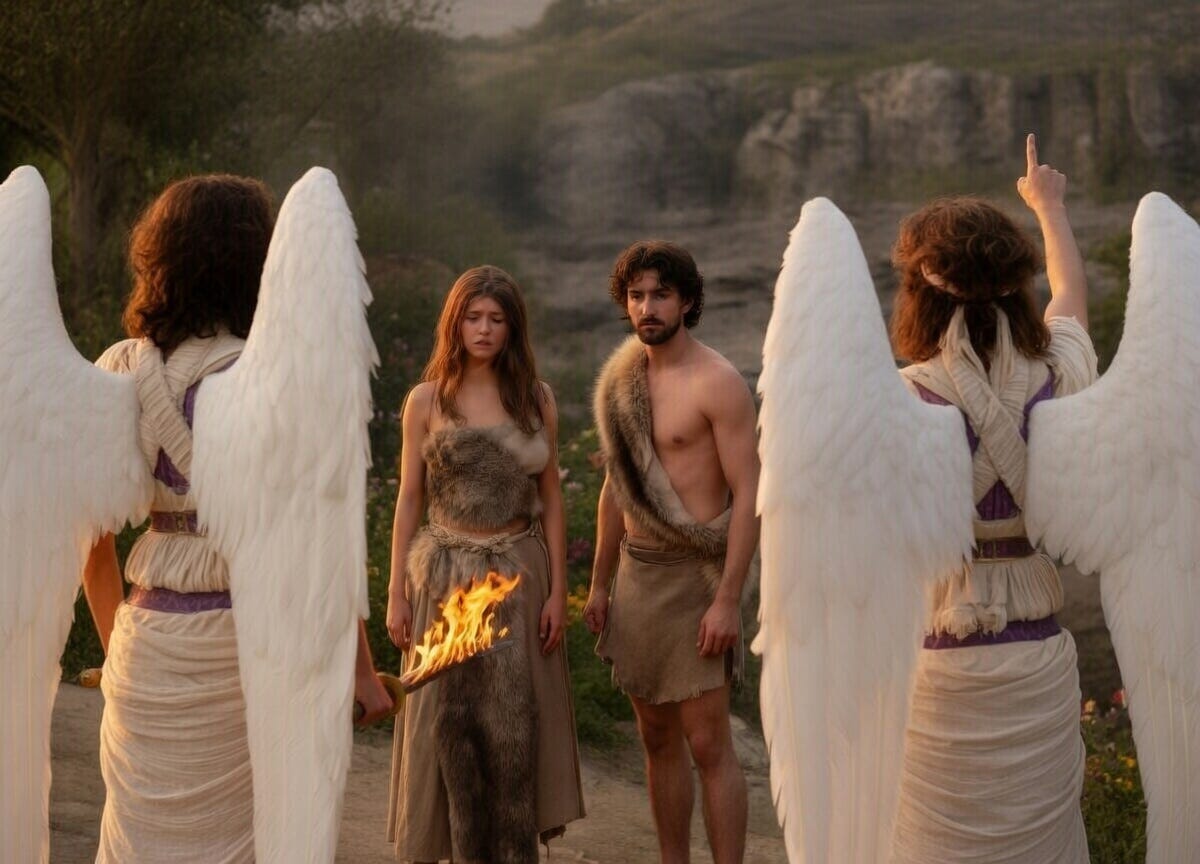
Genesis 3:24 just changed everything
If you grew up in a church, you can picture the scene perfectly: Adam and Eve walking out of the garden with heads down, while two stern angels with flaming swords stand guard like statues at the gate. End of story. Eden is closed. Move on to the next flannelgraph.
But the Hebrew text never says the cherubim were “standing” there like frozen sentries.
Here’s what Genesis 3:24 actually says:
“And He drove out the man, and He caused the cherubim to dwell / tabernacle at the east of the Garden of Eden, and the flame of the whirling sword, to guard the way to the Tree of Life.”
That little verb וַיַּשְׁכֵּן (vayyashken) is the game-changer. It comes from the exact same root as מִשְׁכָּן (mishkan), the word for “tabernacle” that appears over 130 times in the Old Testament. God didn’t just place the cherubim there. He caused living cherubim to dwell, to encamp, to tabernacle at the east gate.
In other words, the Garden of Eden didn’t simply “end” the day Adam fell. It became the first tabernacle on earth, a living sanctuary guarded by active cherubim, with only one entrance (on the east), and a flaming, turning sword, acting like the original veil, blocking the way back to the Tree of Life.
This isn’t a minor translation quirk. It’s a massive shift in how we read the rest of the Bible.
Think about what God had been doing in Eden before the Fall. He walked with Adam and Eve “in the cool of the day” (Genesis 3:8). His presence was right there in the midst of the garden, the original Holy of Holies. Humanity lived inside the sanctuary. Then sin entered, and everything changed…but not in the way most children’s Bibles show.
Instead of abandoning the garden, God set up a protected dwelling place right at its eastern boundary. The cherubim weren’t cold statues. They were living guardians, actively tabernacling there, just as the Shekinah glory would later fill the wilderness tabernacle.
Fast-forward a few hundred years. When God gives Moses the detailed blueprints for the tabernacle in Exodus, He isn’t inventing a brand-new worship system from scratch. He’s giving Israel a portable copy of what He already established at Eden.
Look at the parallels that start jumping off the page once you see this:
One entrance only and it faced east (just like Eden).
Cherubim everywhere woven into the curtains, the veil, and guarding the mercy seat.
God’s glory dwelling in the midst, the same presence that once walked in the garden now fills the tabernacle so intensely that Moses can’t even enter.
Access restricted, blood atonement required, just as coats of skins (the first sacrifice) covered Adam and Eve’s shame.
The wilderness tabernacle wasn’t Plan B after the Fall. It was God’s way of saying, “I still want to dwell with you. I’m bringing a piece of Eden into your wilderness so you can draw near again.”
Every later temple followed the same pattern. And then John drops the ultimate bomb in his Gospel: “The Word became flesh and tabernacled among us” (John 1:14 same Greek word built on the Hebrew shakan idea). Jesus Himself is the true and better Tabernacle. The way back to the Tree of Life is no longer blocked it’s open through Him.
This single verse in Genesis 3:24 reframes the entire story of redemption. Eden didn’t disappear. It became the prototype. Everything that follows, the tabernacle, the temples, and ultimately Jesus, is God’s relentless plan to bring us back inside.
Next Saturday we tackle the question almost nobody asks: Where exactly did Cain and Abel bring their offerings? If Eden had become the first tabernacle, guarded on the east, what does that mean for the very next scene in the Bible?
This is where the whole proto-tabernacle series has been heading. Print it. Share it. Let it stretch how you read your Bible.
Blessings,
William
Follow this Link for Extra context & deeper dives: