
The First Blood Ever Shed Wasn’t Abel’s
Proto-Tabernacle Series - Week 4

Most people, when they think of the first bloodshed in Scripture, picture Cain raising a stone against his brother Abel. Blood spills on the ground. Curse follows. It’s brutal, tragic, and unforgettable.
But that wasn’t the first blood.
Go back one chapter. Rewind to the immediate aftermath of the Fall in Genesis 3.
Adam and Eve eat the fruit. Their eyes are opened. For the first time, they feel shame. They scramble to cover themselves with fig leaves: flimsy, makeshift, already wilting. It doesn’t work. They hide from God among the trees.
Then comes the verse most readers breeze past:
“And the LORD God made for Adam and for his wife garments of skins and clothed them.” (Genesis 3:21)
Garments of skins. Not leaves. Not wool. Skins. Leather. Hide. That means an animal, or animals, died.
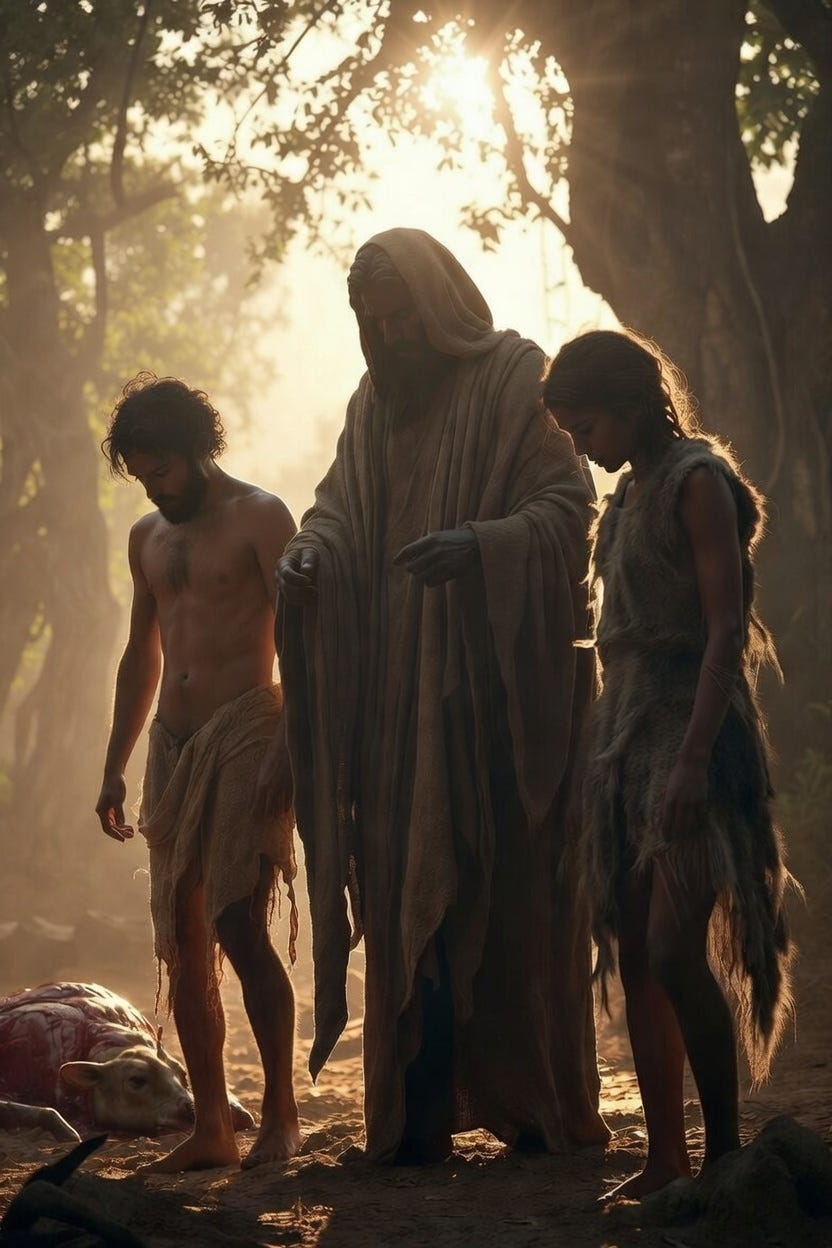
Right there, in the shadow of the very first sin, before any human hand committed murder, God Himself became the first offeror, the first priest, and the first provider of covering. An innocent life was taken so that guilty ones could be clothed. Blood was shed to deal with shame and nakedness. Adam named each animal and cared for them. Those committed to his care pay the price. His sin cost him much more than we think.
That innocent life foreshadowed the Messiah.
This isn’t a minor detail tucked in the margin. It’s the opening line of the gospel preached on planet Earth.
Think about what God could have done. He could have left them in their fig-leaf failure. He could have banished them immediately without mercy. Instead, He acts first, not in wrath, but in grace. He kills to cover. He sheds blood to clothe. He does for them what they could never do for themselves.
From this moment, the entire storyline of Scripture begins to unfold in patterns that all point back here:
Every lamb led to an altar in the patriarchal stories.
Every drop of blood sprinkled on the mercy seat in the tabernacle.
Every sacrifice offered in the temple courts.
Every animal slain under the old covenant law.
All of them echo this first sacrifice in Eden. All of them whisper: Blood must be shed for covering. Innocent life for the guilty. God Himself provides.
The early Christians saw it clearly. They didn’t treat Genesis 3:21 as a curious footnote; they saw it as a shadow of the Messiah. The same divine hands that fashioned those animal skins would one day be pierced with nails, spilling divine blood to clothe sinners in righteousness that never wears out.
This changes how we read the rest of the Bible. It also changes how we see ourselves.
We’re still sewing fig leaves today.
Our versions look different - perfect Instagram feeds, moral scorekeeping, endless productivity, denial of our failures, religious performance - but they’re just as inadequate. They wilt. They don’t cover. They can’t heal shame.
The good news is that God still does what He did in Eden: He provides the covering we can’t make. Not with our efforts, but with a sacrifice we didn’t offer. The last Adam, the true Priest and true Lamb, stood in our place, bled, died, and rose, so that we could be clothed not in temporary animal skins, but in His eternal righteousness.
“For our sake he made him to be sin who knew no sin, so that in him we might become the righteousness of God.” (2 Corinthians 5:21)
That’s why this moment matters. The first blood wasn’t judgment. It was mercy. And mercy still has the first word.
Next Saturday: we walk eastward, out of the garden, to the place God stationed something (or Someone) at the east gate of Eden. It’s not what most people think and it ties everything together even more tightly.
Blessings,
William
See you on the ancient paths.
© 2026 Galilee Publications. Just reading what’s written. Walk with us on the ancient paths.
Follow this Link for Weekly Note Bonus: Extra context & deeper dives: