
The One Piece of Furniture Jesus Said He Was… Which Is All
Proto-Tabernacle Series – Week 7

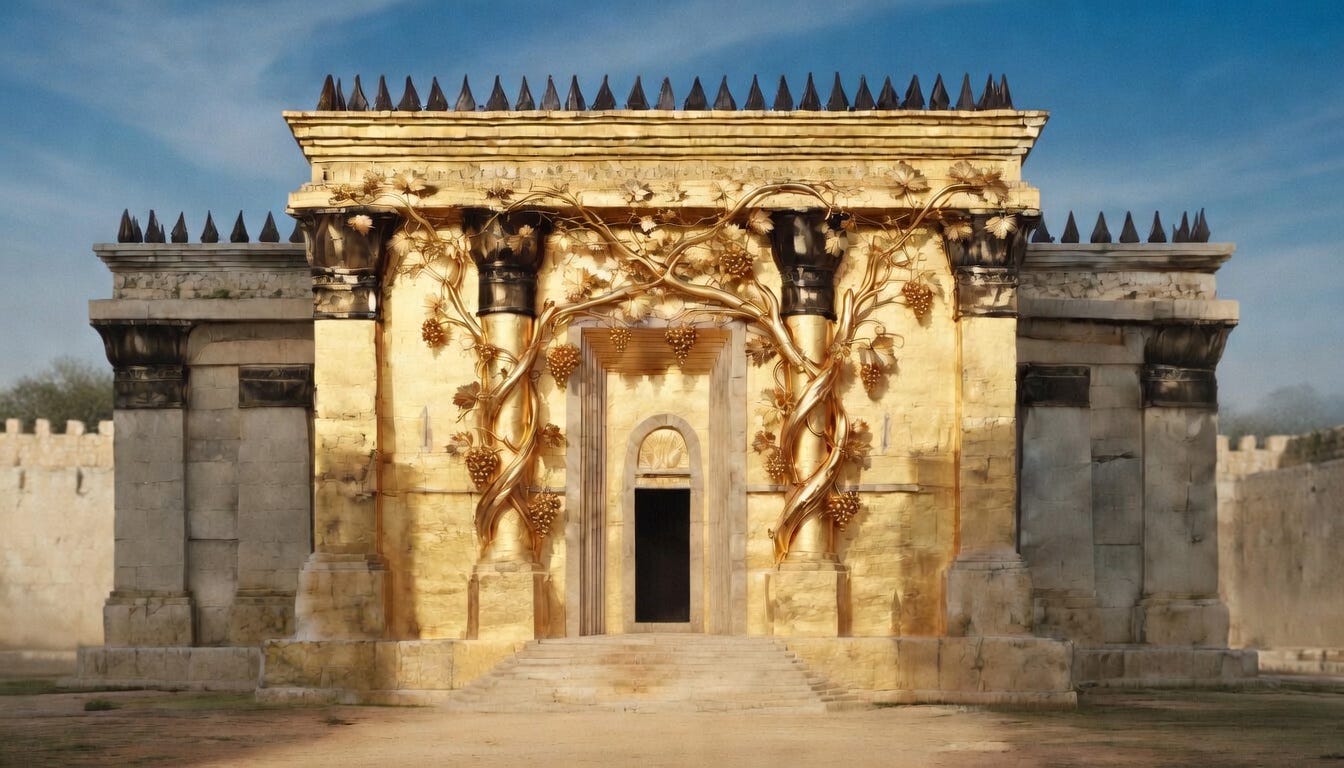
Imagine standing in the shadow of Jerusalem’s massive Temple. The sun glints off its white stones and golden overlays. Pilgrims stream through the eastern gates. And towering above those gates hangs one of the most breathtaking sights in all of Israel: a gigantic golden vine, its branches trained over posts, with grape clusters so large they reach the height of a grown man.
This wasn’t some minor decoration. It was the most famous symbol in the entire nation.
Then a Galilean rabbi looks up and says, calmly and boldly: “I am the true vine.” (John 15:1)
Every Jew listening would have felt the weight of those words immediately.
For over 1,500 years, Israel had lived with symbols pointing to God’s presence and provision. The tabernacle in the wilderness, and later the Temple in Jerusalem, weren’t just places of worship. They were a living, full-color portrait of the coming Messiah.
And Jesus didn’t just step into that portrait. He declared that He was the reality every piece had been foreshadowing.
Let’s start with that golden vine.
The Vine That Everyone Knew
Wine and vines ran deep in Jewish life and worship. Every single day, for centuries, priests poured out a drink offering of wine at the sanctuary (Numbers 28:7). It accompanied the morning and evening sacrifices, a constant reminder of joy, blessing, and dependence on God.
The Hebrew Scriptures repeatedly pictured Israel as God’s vine. Psalm 80:8 sings, “You brought a vine out of Egypt; you drove out the nations and planted it.” Isaiah 5 opens with a love song about God’s vineyard that was supposed to produce good fruit but instead yielded wild grapes.
And then there was the physical symbol everyone could see: that massive golden vine over the Temple’s great eastern entrance.
The Mishnah (Middot 3:8) describes it clearly: a golden vine stood over the entrance to the sanctuary, trained over posts. Anyone who wanted to give a freewill offering of a golden leaf, berry, or cluster would bring it, and the priests would hang it there. It grew more magnificent over time as people added to it.
Josephus marveled at it too. He wrote that over the entrance was “a golden vine with grape clusters hanging from it, a marvel of size and artistry… clusters the height of a man.”
Jesus wasn’t speaking in vague poetry. He was standing in sight of that very symbol and saying, “I am the true vine.” Not the golden copy. Not the nation that had so often failed to bear fruit. The real thing. The fulfillment.
And that wasn’t the only time He did this.
Jesus Claimed Every Piece of the Tabernacle Furniture
The tabernacle (and its later Temple version) contained sacred items whose design and purpose God gave in painstaking detail in Exodus. Each one pointed forward.
Here’s how Jesus stepped into each one:
Table of Showbread (north side of the Holy Place): Twelve fresh loaves sat before God every week, representing His constant provision for His people. Jesus said: “I am the Bread of Life” (John 6:35). “I am the living bread that came down from heaven.”
Golden Lampstand (Menorah) (south side of the Holy Place): The only light inside the Holy Place — seven flames that never went out — symbolizing God’s illuminating presence. Jesus declared: “I am the Light of the World” (John 8:12). Whoever follows Me will never walk in darkness.
Altar of Burnt Offering (in the outer courtyard): Where all the blood sacrifices were made — daily, yearly, for sin. John the Baptist introduced Jesus as “the Lamb of God who takes away the sin of the world” (John 1:29). Hebrews ties this directly to Jesus’ once-for-all sacrifice.
Bronze Laver (between the altar and the Holy Place): Priests had to wash their hands and feet before serving — cleansing for ministry. Jesus offered “living water” (John 4) and washed His disciples’ feet (John 13), showing the deeper cleansing He provides.
Altar of Incense (just before the veil): Sweet smoke rising into God’s presence, representing prayers ascending. Jesus is our great intercessor. Prayers rise in and through Him (Hebrews 7:25; Revelation 8:3-4).
Mercy Seat (above the Ark in the Most Holy Place, between the two cherubim): Once a year, the high priest sprinkled blood here for the nation’s atonement. Paul calls Jesus our “propitiation” or “mercy seat,” (hilastērion in Greek, Romans 3:25) the place where God’s justice and mercy meet.
Jesus didn’t claim just one piece of furniture. He claimed them all.
The tabernacle wasn’t random furniture in a tent. It was a carefully arranged, God-designed picture of how sinful people could draw near to a holy God, and ultimately, of the One who would make that possible.
Jesus walked straight into that ancient portrait and said, “That’s Me. Every part of it.”
Why This Matters
This isn’t clever typology read back into the text after the fact. The connections are rooted in the Old Testament’s own imagery, the daily rituals of the Temple, and symbols every first-century Jew would recognize. When Jesus made these “I am” statements, He was announcing that the shadows had found their substance in Him.
The Temple system pointed to a greater reality. Jesus embodied it.
Next week we’ll look at “Five Times Jesus Showed Up Before Bethlehem.” We are now halfway through the Proto-Tabernacle series. Any comments or thoughts you’d like to share, we would love to hear from you.
See you next Saturday as we continue to walk these ancient paths together.
Blessings,
William
Follow this Link for Extra context & deeper dives: